-min.jpeg)
The easiest way to get started with Amazon FBA (explained step by step)

You want to sell your own product on Amazon, but don't have much time or a large budget. This is exactly what Amazon FBA is made for. If you follow a few important basic rules, you can build up a real income alongside your job, school or studies.
The good news is that you don't need complicated structures, a limited company on the first day or a warehouse. What you need above all is a sensible product and a clear plan.
This article deals with five key questions that you need to answer if you want to launch on Amazon. You'll find out how to find a product, whether it's worthwhile, how to procure it, how to officially launch and how customers discover your offer in the first place.
In the end, you will have a simple step-by-step process that you can follow to start your own Amazon FBA product.
The 5 most important steps to selling successfully on Amazon
Before we go into detail, here are the five key questions you should answer:
- What do you want to sell anyway?
- How do you want to store and ship?
- Where can you find a supplier for your product?
- How do you officially become self-employed?
- What do you need to do so that customers find your product?
These five points form the common thread. If you go through each point properly, the chances of your product not ending up as a failure but generating stable sales increase significantly.
Step 1: Finding the right product - the foundation of your success
Everything starts with the product. If the product is weak, even the best marketing won't help. Then the whole thing collapses like a house of cards.
Many start with ideas such as: "You should sell this or that." The problem: "You should" doesn't pay the bills. The decisive factor is whether real customers are actively looking for something and the competition is not yet offering it well.
Product research with software instead of gut feeling
Professional retailers therefore rely on tools such as Helium 10 Black Box. This is essentially a product database that has access to data on over two billion Amazon items.
With this type of software, you can open a back door into Amazon, so to speak, and search specifically for products that suit you.
A typical procedure:
- First select a category, for example "Kitchen, household, living".
- Within the category, narrow it down further, for example to "Storage and organization" or "Crafting, painting, needlework".
- You can exclude areas such as electrical kitchen appliances, vacuum cleaners or household cleaners if you prefer simple, non-electrical items.
- Then filter by price and desired monthly turnover.
The software will then show you a list of suitable product ideas.
These can be, for example:
- a couch bar (a box that you place on the sofa for drinks and snacks)
- a folding box for storage
- a scented candle made from soy wax, vegan, with premium positioning
For each product, you receive direct data such as sales price and estimated monthly turnover.
Practical example:
A scented candle is sold for 29.99 euros and generates around 5,300 euros in sales per month. This allows you to recognize at a glance whether a niche can be economically interesting.
What makes a good Amazon product
To turn an idea into a real opportunity, you need clear criteria. A useful product fulfills three conditions:
- It is profitable.
- There is demand.
- The competition is not too strong.
A sensible price range also helps.
1. demand: Are customers really looking for it?
Enter your main term on Amazon, for example "scented candle" or "pizza ball box". Take a look at the first ten results.
The signals for demand:
- Most of the top 10 products generate four-figure monthly sales or more.
- The products appear up-to-date, images and texts are well maintained, and sales are active.
This way you can see whether there is enough "cake" to secure a piece of.
2. competition: How strong are the other retailers?
A simple but very helpful look: the number of reviews.
- In highly competitive niches, such as cell phone cases, top sellers often have thousands of reviews.
- If you start there with a new product and zero reviews, you will have a very difficult time.
Rather look for niches in which:
- as few products as possible in the top 10 have over 250 ratings
- at least five products are below 100 ratings
Then you have a realistic chance of building visibility and sales with a new product.
3rd price: Enough buffer for profit
Very cheap products are tempting at first glance, but the margin is quickly eaten up. You have purchasing, fees, shipping, maybe advertising.
A sensible framework is:
- Selling price between 25 and 80 euros
In many cases, a decent profit per unit can be achieved in this area, even if costs are added.
Analysis with Helium 10 Xray: Example "Pizza bale box"
Many retailers use a browser tool such as Helium 10 Xray to check demand, sales and competition even more closely.
For example, you search for "Pizzaballenbox" and start the tool. It reads the offers on the first results page and creates a table with price, turnover and ratings.
A simplified example:
ProductPriceMonthly SalesReviewsPizza Ball Box A€24.99€33,500230Pizza Ball Box B€27.99€9,700150Pizza Ball Box C€29.99€13,20080Pizza Ball Box D€21.99€4,80060
What is interesting about it:
- Most prices are over 20 euros.
- There are four-digit to five-digit sales.
- There are products with many, but also with significantly less than 100 ratings.
Despite some strong offers, there is still room for new retailers. Retailers with fewer ratings are already achieving good sales. This is a sign of weaker competition.
Calculating profitability correctly
If an idea convinces you, you have to do the math. That's the only way to know if you're really making money.
These include:
- Product costs at the manufacturer
- Quality control before dispatch, for example through an inspection
- Transportation costs to the destination country
- Customs and import sales tax
- then you can calculate the effective purchase price per unit
On the sales side, there are also:
- your merchant account with Amazon, Seller Central, at around 99 euros per month plus VAT (there is also a free version for pure hobby sellers)
- the sales commission of up to 15 percent of the sales price in many categories
- for FBA storage and shipping fees from Amazon per item
A good guideline is this simple tripartite division:
- about one third of the sales price for purchasing
- about one third for fees and shipping
- the last third as profit
This is not a rigid rule, but it is a solid goal.
Example calculation with profitability calculator: Pizza bale box
Many traders use Helium 10's profitability calculator to run through all these items in seconds.
You choose an existing product whose data matches your idea and let the software do the work. The computer takes over, for example:
- Selling price
- Dimensions and weight
- Estimated shipping costs
- Estimated production costs (you can adjust these)
Assuming a set of four silicone boxes for pizza dough costs you around 1 euro each, that is just over 4 euros per set.
The calculation can then look like this:
ItemAmount per setSelling price€37.99 (example)Production costapprox. €4.00Selling fee (15%)€5.70FBA shipping and storage€5.20Other costs (transport, etc.)AssumedmarginProfit per sale€13.58Profit marginapprox. 42%
In the practical example, around 241 units are sold per month.
Invoice:
- 13.58 Euro profit per unit
- times 241 units per month
- results in a monthly profit in the mid four-digit range, just with this one product
Most retailers have several items in their range. This gradually creates a stable income.
Step 2: Store and ship - FBA or send it yourself?
Once it is clear what you want to sell, you need an answer to the question: Who will store and ship the goods?
There are basically two ways:
- FBM (Fulfilled by Merchant), you ship yourself
- FBA (Fulfilled by Amazon), Amazon does warehousing and shipping for you
FBM: Everything in your own hands
At FBM:
- You accept the goods directly from the manufacturer.
- You store at home, in the garage or in your own warehouse.
- Each order is packed by you and handed over to the parcel service.
This can be useful if:
- you want to experience everything yourself at the beginning
- you have a lot of space
- you sell very large or bulky products where FBA would be expensive
However, FBM is often cumbersome for a system that can be scaled well.
FBA: Amazon takes care of warehousing and shipping
With FBA, you send your goods to an Amazon warehouse. This can be done directly from abroad, you don't even have to touch the boxes yourself.
The processes:
- Your delivery arrives at the Amazon warehouse.
- An employee puts your products on the shelf.
- When an order is placed, Amazon takes the product, packs it in a box, adds filling material and hands it over to a shipping service.
Advantages:
- You don't have to set up a warehouse.
- You have hardly any work with shipping and returns.
- Amazon often ships cheaper than you could privately.
- Products with FBA are often suitable for Prime, which gives customers confidence.
FBA is therefore the clearly preferred option for most beginners.
Step 3: Find suppliers - from the first contact to the offer
Now you need someone to manufacture your product in the first place.
There are two major paths:
- Suppliers in your own country
- Suppliers abroad, often Asia or especially China
Suppliers in Germany
If you want to produce in Germany, you can:
- Search for manufacturers on Google
- Visit trade fairs and make contacts there
The routes are often somewhat more expensive, but can offer shorter supply chains and simpler communication.
Suppliers in Asia, especially China
Many Amazon retailers have production in Asia because there is a large selection of factories there for all kinds of products.
There are two approaches to this:
- You commission an agency to find a supplier for you. These service providers often start at 2,000 to 3,000 euros.
- You search yourself via platforms like Alibaba.
Countless manufacturers are listed on Alibaba, mainly from China. The site works in a similar way to Amazon:
- You have a search bar at the top.
- Enter your product name, for example "Pizza ball box".
- You will find many suppliers who produce something like this.
A typical good provider shows:
- have been active on the platform for several years, for example "7 years"
- Labeled as "verified", i.e. checked on site by the platform
- "Trade Assurance", a kind of security for your order
- Information on prices depending on quantity
You can write to the manufacturer, for example:
- Request for 250 pieces
- with price indication please including shipping to Germany
Most factories cater to international customers and can send you a complete quote, including transportation.
This will give you a solid basis for your calculation.
Step 4: Start officially - simple business registration instead of GmbH
Many newcomers immediately think of a GmbH because it sounds reputable and provides legal protection. This is often not necessary when starting out on Amazon.
Most customers only look at Amazon anyway:
- Product images
- Price
- Reviews
- Title and layout
The company name hardly plays a role, many buyers don't even click on the retailer information.
Why business registration is usually enough
For most beginners, a simple business registration is the best way to go:
- You go to the responsible office in your city.
- Everything is done in about 15 minutes.
- The costs are usually between 15 and 20 euros.
This is quick, inexpensive and saves you months of preparatory work, as is the case with a GmbH.
Settings in Amazon Seller Central
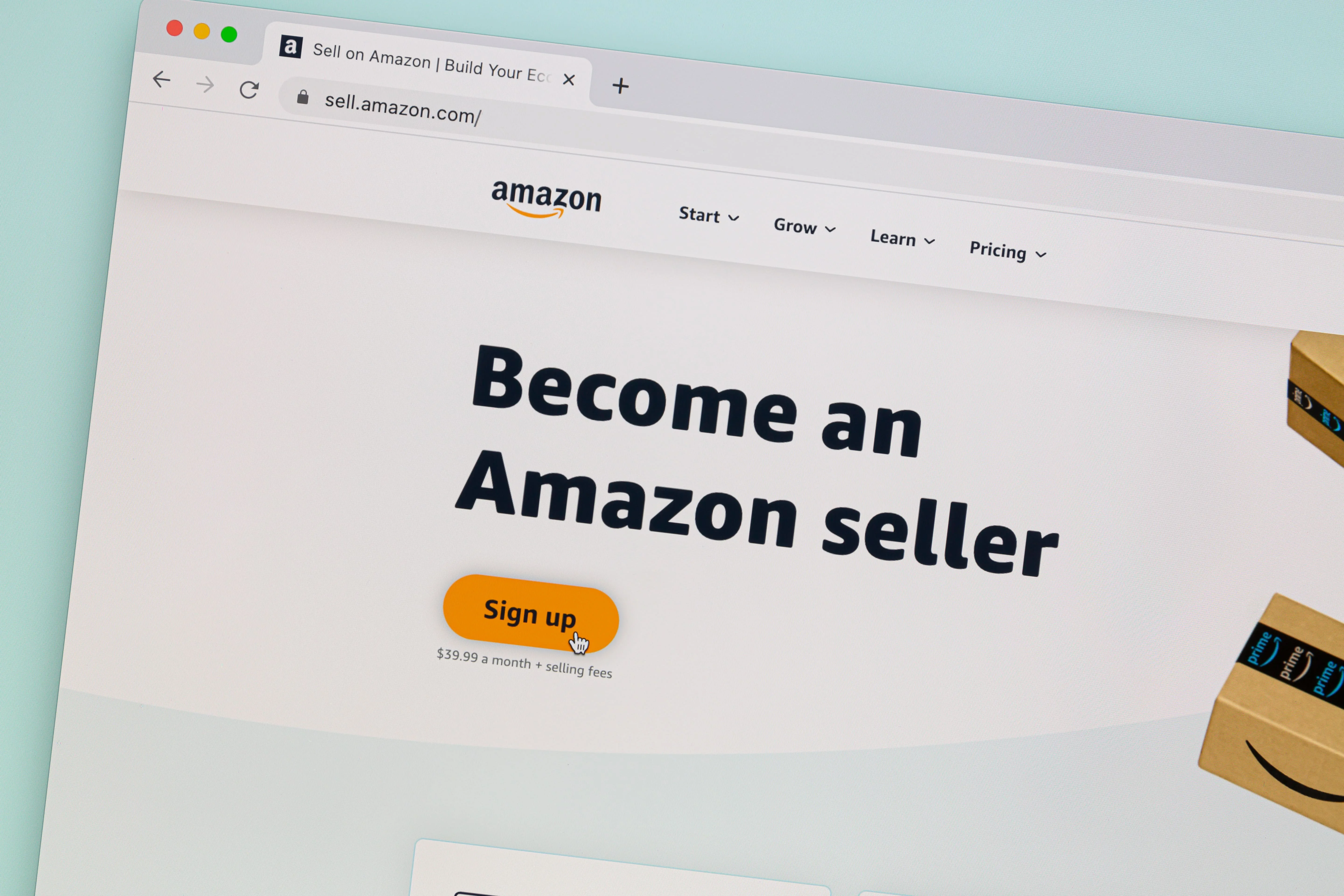
If your business is registered, you can register as a seller in Amazon Seller Central.
Important to know:
- You need an e-mail address, which can be the same as your private buyer account or a new one.
- You define a store name that can be freely chosen.
- You assign a brand name for your product, also freely selectable.
Store name and brand name:
- do not have to have anything to do with your official business name
- do not necessarily have to be registered somewhere to start selling
- can be pure fantasy names
Of course, you can also name everything the same way if you prefer. The important thing is that you clearly know which name appears where.
Step 5: Find customers - with strong photos, texts and advertising
If your product is on Amazon, it is initially invisible to customers. You have to make sure that it is searched for and found and that customers decide in favor of your offer.
There are three major levers:
- Pictures
- Texts with the right search terms
- Initial marketing measures such as discount vouchers and advertisements
Product photos: the most important sales factor
If you surf Amazon on your cell phone, you see it first:
- a small piece of the title
- then immediately the product images
Many users hardly read any text any more, but make decisions based on what the photos convey.
Good pictures should:
- show the product clearly and large
- explain the application
- Making advantages visible
- Short keywords included in the image, such as: "BPA-free", "dishwasher-safe", "for 4 pizza dough balls"
With strong images, you answer many questions before they even arise.
Product texts: writing for people and for search
On your product page you have:
- the title
- the bullet points
- the detailed description
Texts fulfill two tasks:
- They explain to the customer what they are getting and how they will benefit from it.
- They show Amazon which search terms your product should match.
Many customers do not search for a single term. Instead of "pizza bale box", for example, they type:
- "Pizza dough box with lid"
- "Pizza dough box"
- "Dough box for sourdough"
- "Dough ball box"
- "Dough tray 40 cm"
- "Pizza dough box 30 cm"
You can find these terms with a keyword tool like Helium 10 Magnet. You enter a main term, display related search terms and build the relevant words step by step:
- Title
- Bulletpoints
- Description
in.
The more meaningful search terms you include, the more often Amazon can show your product to suitable customers.
Trigger initial sales: Coupons and ads
A new product often starts at the bottom of the search results. Without sales, it hardly rises to the top.
So you need a starting boost.
Two very direct levers:
- Discount vouchers (coupons)
- Advertisements within Amazon (sponsored products)
For example, a coupon is displayed with "Save 5%" in green next to your offer. This catches the eye and brings additional clicks and orders, especially if you are new to the niche.
Sponsored products are ads that are labeled "sponsored". Retailers pay a few cents per click so that their product is displayed before others.
Combine at the beginning:
- good photos
- search engine optimized texts
- small discounts
- Targeted ads
then the chances increase greatly that your product will quickly receive its first reviews and become organically visible in the long term.
Conclusion: Start your own Amazon FBA business with a system
Getting started with Amazon FBA may seem complex at first glance, but it can be broken down into a few clear steps. You need a strong product that is demonstrably in demand, has manageable competition and can be sold at a price that still leaves a decent profit after all costs.
With FBA, you can outsource warehousing and shipping and concentrate on selection, procurement, costing and marketing. A simple business registration is all you need to get started and legal hurdles are kept to a minimum.
It is crucial that you don't act on instinct, but work with data, make clean calculations and design your product page in such a way that customers understand it and Amazon finds it. If you implement this process step by step, the path to your first own product on Amazon is clearly mapped out.

Related Articles